Case study · Thesis project · 2026
TulongGuro
AI-Assisted Grading and Classroom Management System
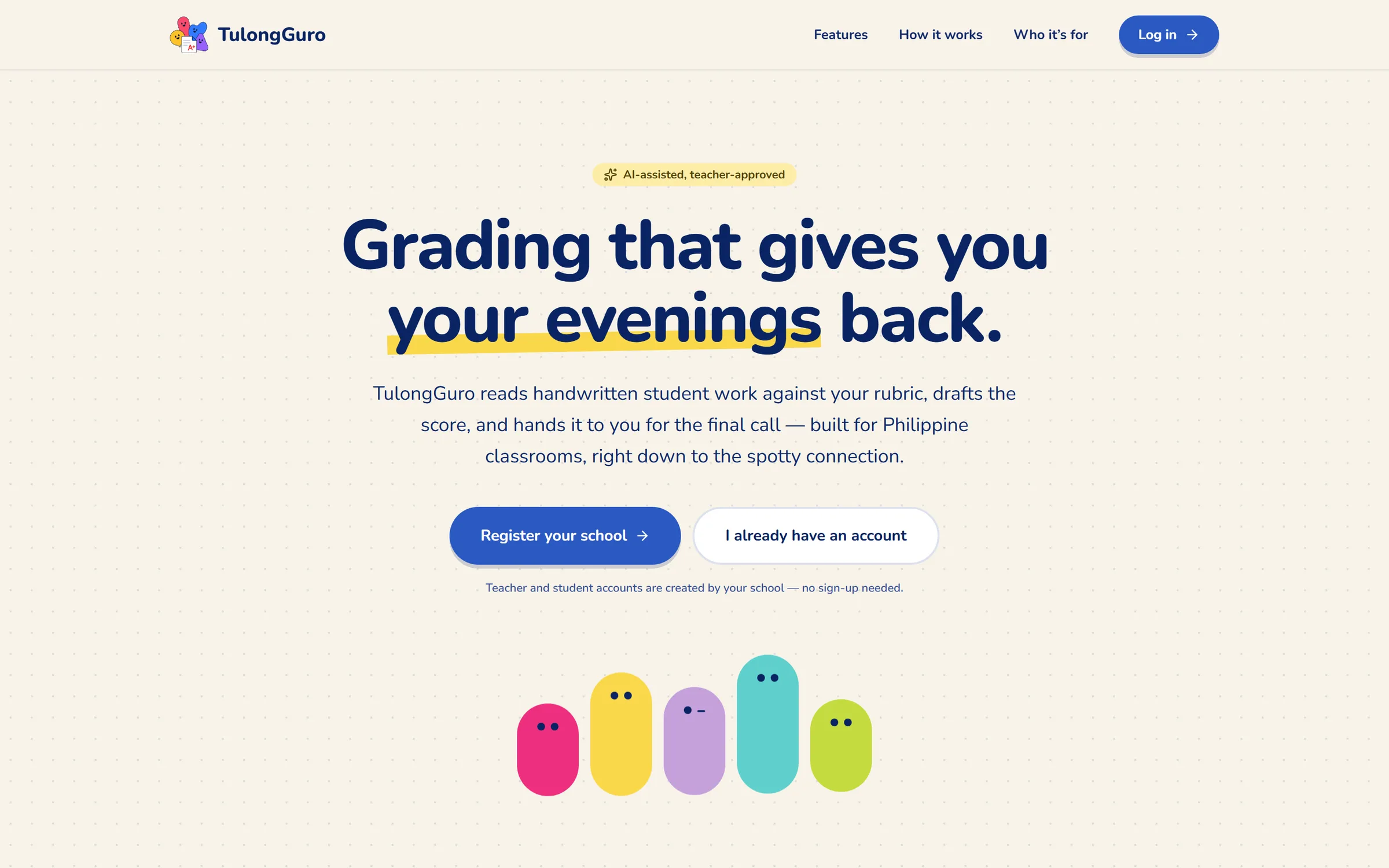
A thesis project for the Computer Science program at Holy Angel University. TulongGuro is a learning management system for teachers in which a vision-language model reads student work, including photos of handwritten essays, against the teacher's rubric and drafts a score and feedback. The teacher reviews, edits and approves every result before a student sees it.
The problem
Large classes and paper-based workloads make timely, personal feedback hard for Philippine public school teachers, and most learning management systems only record grades. TulongGuro drafts rubric-based feedback on Grade 6 English work so the teacher can spend their time reviewing it instead of writing it from scratch.
What it does
- AI-assisted checking: the model reads handwritten or typed submissions and drafts rubric-aligned scores, strengths, areas for growth and next steps.
- Human-in-the-loop review: teachers validate and can edit every AI draft, and releasing grades to students is a separate step.
- Separate Teacher, Student and Admin interfaces; school admins manage sections, course shells and student rosters.
- Progress dashboards that track mastery of curriculum competencies across activities.
- Badges that students earn from performance and milestones.
- Delivered as a progressive web app, so it runs on desktop and phones without an app store.
Engineering decisions
- The AI drafts; the teacher decides
- Validation and release are separate acts, so a grade reaches a learner only after the teacher has reviewed the set and published it. The thesis abstract reports that raw AI drafts matched teacher-set performance bands in only about a quarter of cases, which is why the system is positioned as decision support and not as an automatic grader.
- Images are prepared on the server before the model sees them
- Photographed or uploaded work is optimised server-side, then read and scored against the rubric in a single model call.
- A fallback model keeps checking available
- Checking rotates between a primary and a fallback Gemini Flash model, so a class is read to one standard whichever one answers.
My contribution
I co-developed TulongGuro in a four-member thesis team: a learning management system in which a Gemini vision-language model reads typed or handwritten student work against the teacher's rubric and drafts scores and feedback. I kept teachers in control with a human-in-the-loop review flow, where every AI draft is validated and editable and releasing grades to students is a separate step, and delivered separate Teacher, Student and Admin interfaces as a progressive web app, with progress dashboards for curriculum competencies and student badges.
Technologies
- React 19
- Vite
- Tailwind CSS 4
- React Router
- Node.js
- Express 5
- Prisma
- PostgreSQL (Supabase)
- Supabase Storage
- Google Gemini (Generative AI SDK)
- PWA
- Vercel & Render